Have you ever seen someone type “LOL” in a chat and wondered if they’re *actually* laughing? 🤔 If yes, you’re not alone. In today’s fast-paced digital world, LOL meaning in text has evolved far beyond its original purpose. What used to mean “laughing out loud” now carries multiple layers—humor, politeness, sarcasm, emotional tone, and even social cues.
As conversations shift from in-person to digital, understanding what LOL truly means can help you avoid misunderstandings, connect better, and communicate confidently—whether you’re texting friends, chatting on Instagram, or messaging in a professional space.
This expert guide breaks down everything you need to know about LOL meaning in text, including examples, variations, emotions, and modern usage trends.
What Does LOL Mean in Text? 🤔
LOL stands for Laughing Out Loud. In texting, chats, and social media, it’s used to show that something is funny, entertaining, or surprising.
But here’s the important part — *in 2025, LOL doesn’t always express real laughter.* Many people use it to:
- Soften a message 😊
- Avoid sounding rude 🙃
- Show friendliness 🤝
- Fill silence 😅
- Express mild amusement 😏
This means the lol meaning in text depends on the context, tone, and relationship between the people talking.
The Evolution of LOL (How Its Meaning Changed Over Time)
Originally, LOL was used only when someone was *actually laughing out loud*. But digital communication changed everything. Emojis, memes, and short-form texting made LOL evolve into a more flexible expression.
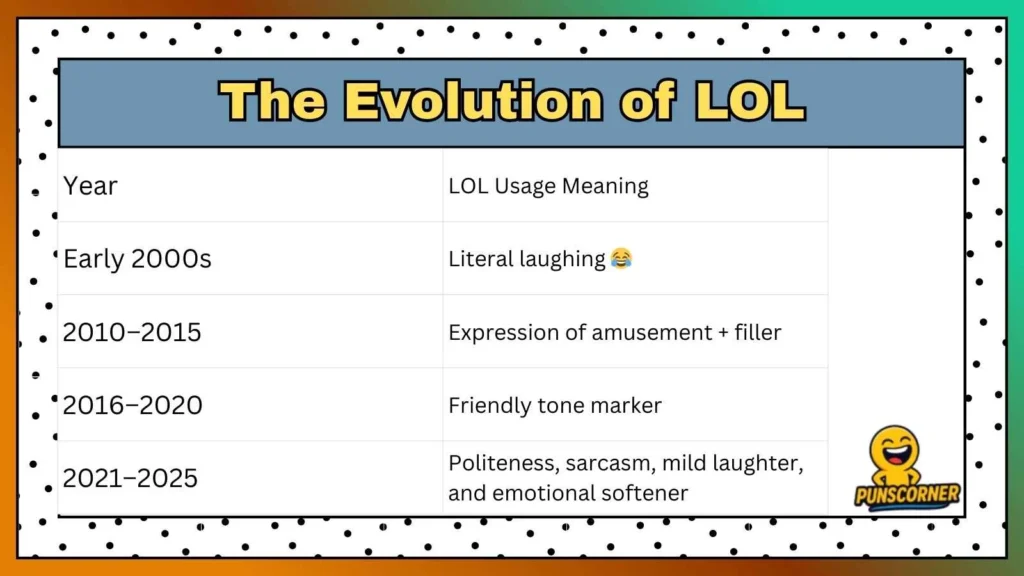
Here’s how LOL has changed over the years:
| Year | LOL Usage Meaning |
|---|---|
| Early 2000s | Literal laughing 😂 |
| 2010–2015 | Expression of amusement + filler |
| 2016–2020 | Friendly tone marker |
| 2021–2025 | Politeness, sarcasm, mild laughter, and emotional softener |
Common Meanings of LOL in Text (With Examples)
1. Literal Laughter 😂
When something is genuinely funny.
Example: “That meme you sent… LOL I can’t stop laughing.”
2. Polite Response 🙂
When you want to respond casually without sounding dry.
Example: “Oh really? lol that’s interesting.”
3. Softening a Message 😅
Used to avoid sounding harsh.
Example: “You’re late again lol.”
4. Sarcasm 😏
Sometimes LOL is used to show passive humor or irony.
Example: “Yeah, that totally worked out… lol.”
5. Ending a Conversation 🤷♂️
People use LOL to casually wrap up chats.
Example: “Anyway lol I’ll talk to you later.”
When to Use LOL in Text (And When You Shouldn’t)
Choosing the right moment to use LOL is important. Using it too much may look careless, while using it too little can make you seem serious.
Use LOL When:
- You want to show friendliness 😊
- You’re reacting to humor 😆
- You want to keep the tone casual
- You’re avoiding awkwardness 😬
- You’re responding lightly to a small mistake
Avoid LOL When:
- Talking about something emotional or serious 💔
- Messaging professionally (work, clients, teachers)
- Clarifying important details
- You might sound dismissive without meaning to
LOL vs Other Similar Slang Terms
People often mix LOL with other modern slang. Here’s how they differ:
| Slang | Meaning | Intensity |
|---|---|---|
| LOL | Laughing Out Loud | Light |
| LOLZ | Playful version of LOL | Light–Medium |
| LMAO | Laughing My A** Off | Medium–Strong |
| ROFL | Rolling On the Floor Laughing | Very Strong |
| OMG LOL | Big laughter + surprise | Strong |
Emotional Meanings of LOL: What People Actually Feel
Sometimes LOL means something much deeper than laughter. It can express:
- Confusion — “lol what?”
- Shyness — “haha lol yeah”
- Embarrassment — “lol my bad”
- Nervousness — “ok lol”
- Awkwardness — “lol idk what to say”
In digital communication, LOL often acts as an emotional shield.
Short Funny LOL Examples You Can Use
- “Bro your cat looks offended lol” 🐱
- “I thought today was Friday… lol nope”
- “I tried cooking and almost burned the house lol”
- “That movie plot twist? lol what”
- “I’m late again lol classic me”
LOL in Professional Texting: Is It Okay?
Using LOL at work depends on your environment. In modern culture, many coworkers use emojis and light slang, but LOL can still feel unprofessional in some contexts.
Okay to Use LOL When:
- You’re close to the coworker
- The chat is casual
- You’re reacting to a workplace joke
Not Okay to Use LOL When:
- Talking to clients or supervisors
- Sharing instructions or reports
- Discussing serious matters
LOL Meaning in Different Cultures 🌍
Not everyone uses LOL the same way. Some cultures use alternatives like:
- “kkk” (Brazil) → laughter
- “555” (Thailand) → “haa haa haa”
- “jajaja” (Spanish) → “hahaha”
- “ㅎㅎㅎ” (Korea) → soft laughter
So the lol meaning in text can also change depending on language and region.
Why LOL Still Dominates in 2025
Even with emojis and GIFs taking over, LOL remains one of the most typed expressions online. Why?
- It’s simple
- It’s universal
- It fits every platform
- It’s neutral and friendly
- It works for both real and fake laughter
LOL has become more than slang — it’s a digital communication tool.
FAQs
1. Is LOL rude?
No, LOL is usually friendly. But in sarcastic contexts, it can sound dismissive.
2. Does LOL mean I’m laughing?
Not always. Many people use LOL simply to keep the conversation light.
3. What does LOL mean from a girl or guy?
It usually means amusement or politeness. Context matters more than gender.
4. Is LOL outdated in 2025?
No. Even with emojis and memes, LOL is still widely used worldwide.
5. What’s stronger than LOL?
LMAO, ROFL, or even 😂 emojis show stronger laughter.
Conclusion:
The LOL meaning in text may seem simple, but it’s actually a powerful communication tool. It can express humor, friendliness, sarcasm, awkwardness, or emotional tone — depending on the situation.
Understanding how LOL works helps you communicate better, avoid confusion, and respond more naturally in digital conversations.