When someone texts you “IDTS”, your first reaction is usually confusion. 🤔 If you’ve ever paused in a conversation, wondering what this short slang means, you’re not alone.
The phrase “idts meaning in text” is searched thousands of times because people see it on social media, in chats, and even in professional conversations.
In this detailed guide, you’ll learn the exact meaning of IDTS, how it’s used, when you should (and shouldn’t) use it, real examples, alternatives, and everything else you need to communicate confidently. ✨
What Does IDTS Mean in Text? 🤔
The abbreviation IDTS stands for “I Don’t Think So.” It’s a quick, casual way of disagreeing with someone without sounding rude. People commonly use it in texting, social media comments, group chats, and everyday conversations.
Because the popularity of short-form texting increases every year, slang like IDTS has become a normal part of digital communication. That’s why so many people search for the idts meaning in text when they first encounter it.
Why Do People Use IDTS? (Simple Explanation)
People use IDTS because it’s:
- ✔ Short and quick to type
- ✔ Polite compared to saying “No, you’re wrong”
- ✔ Common in casual and semi-formal chats
- ✔ A way to express mild disagreement
IDTS sounds softer than saying “No,” which makes it useful in friendly conversations.
Examples of IDTS in Real Conversations 💬
Here are clear examples so you fully understand the idts meaning in text and how it’s used:
| Situation | Message Example |
|---|---|
| Disagreeing politely | “IDTS, the meeting isn’t today—it’s tomorrow.” |
| Reacting to a rumor | “IDTS, she wouldn’t say something like that.” |
| Responding to a guess | “IDTS, I think you misheard.” |
| Casual chat with friends | “IDTS bro, that’s not how it works 😂” |
| Correcting someone softly | “IDTS, the answer is different.” |
Is IDTS Rude? 😳
Not really. The phrase isn’t rude by itself, but the tone of the conversation matters.
Friendly tone: “IDTS, but you might be right!” 🙂 Rude tone: “IDTS. Stop talking.” 😒
So it depends on how you use it.
How to Use IDTS Correctly (With Rules)
To communicate clearly, follow these simple rules:
- Use it in casual conversations — friends, family, classmates.
- Avoid using it in formal situations like business emails.
- Use emojis if you want to soften the tone.
- Keep the context clear so the message doesn’t feel abrupt.
Good example: “IDTS 😅 but let me double-check.”
Bad example: “IDTS.” (Too blunt and cold)
What Does IDTS Mean on Social Media? 📱
Platforms like TikTok, Instagram, and Twitter use slang heavily. IDTS is often used in:
- Comments
- Reactions
- Replies to opinions
- Meme posts
Example:
“IDTS, that filter doesn’t look natural 😂”
Because of its short length, IDTS fits perfectly into fast, expressive conversations on social platforms.
Other Meanings of IDTS (Rare but Possible)
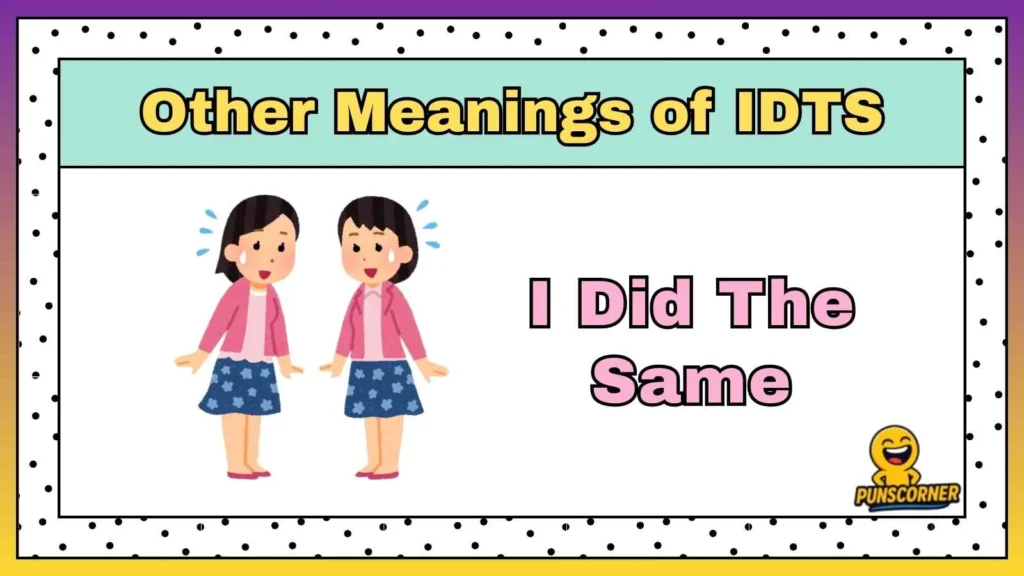
Although the most common meaning is I Don’t Think So, here are rare alternatives used in specific communities:
- I Don’t Think So! (emphasized version)
- I Did The Same (very uncommon)
- Internet Data Transfer System (technical field)
But in texting and chat, it almost always means I Don’t Think So.
How IDTS Became Popular (Short History)
Texting slang exploded in the early 2000s, but IDTS became mainstream around the rise of smartphones and social media apps. Users needed shorter, more expressive ways to communicate, and IDTS became a quick tool to express disagreement.
Now, even people in their 30s and 40s use this abbreviation daily.
Alternatives to IDTS (Use These Instead)
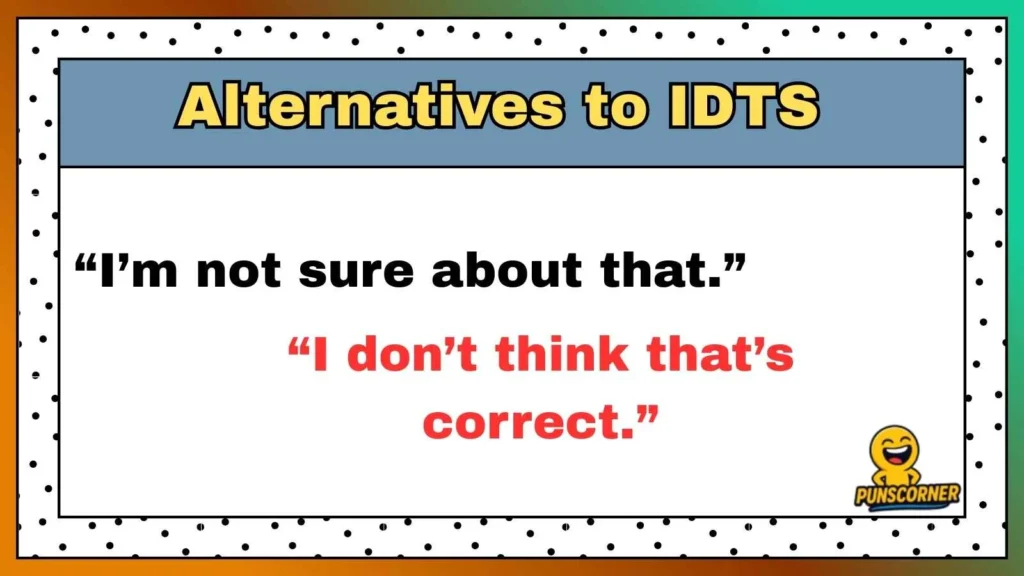
If you want to avoid sounding too casual, use these alternatives:
- “I’m not sure about that.”
- “I don’t think that’s correct.”
- “Probably not.”
- “I disagree, but let’s check.”
- “Doesn’t seem right to me.”
These sound friendlier and more professional if needed.
Variations of IDTS (People Use These Too)
- IDK – I Don’t Know
- IDRC – I Don’t Really Care
- IDTT – I Don’t Think That
- IDTS? – Asking if someone disagrees
- IDTS!! – Strong disagreement
Understanding these will help you navigate conversations more confidently.
How to Reply When Someone Says IDTS
Depending on the situation, you can reply like this:
- Polite reply: “Oh ok, what do you think instead?”
- Friendly reply: “Haha maybe you’re right 😄”
- Confident reply: “IDTS either. Let’s check it.”
- Clarifying reply: “Why do you think so?”
Always match the tone of the conversation.
Is IDTS Appropriate for Professional Use?
In most cases: No.
You should avoid IDTS in:
- Client emails
- Work reports
- Formal conversations
- Academic writing
Instead, use a professional alternative like:
“I don’t think that’s accurate, but let me verify.”
Common Misunderstandings About IDTS
New learners often misunderstand IDTS:
- They think it means “I Don’t Think So?” (question form — it’s not)
- They think it’s rude (not necessarily)
- They think it’s only for teenagers (not true)
- They confuse it with IDK
Understanding the right meaning helps you avoid communication issues.
Where You’ll Commonly See IDTS
- Instagram comments
- Snapchat replies
- WhatsApp chats
- Discord servers
- Group messages
- Facebook posts
- Casual work chats
Because of its versatility, IDTS fits almost every informal context.
Why IDTS Works Well in Modern Communication
Short abbreviations like IDTS work because:
- People type fast
- Conversations move quickly
- Attention spans are shorter
- Mobile texting encourages short responses
It’s simply easier to type “IDTS” than “I Don’t Think So.”
Table: IDTS vs. Similar Slang
| Slang | Meaning | Usage Type |
|---|---|---|
| IDTS | I Don’t Think So | Light disagreement |
| IDK | I Don’t Know | Uncertainty |
| IDC | I Don’t Care | Disinterest |
| IMO | In My Opinion | Opinion sharing |
| TBH | To Be Honest | Honesty |
FAQs
1. What does IDTS mean in text?
It means I Don’t Think So. It’s used to show mild disagreement.
2. Is IDTS rude?
No. It depends on tone. Adding emojis helps soften the message.
3. Can I use IDTS in professional communication?
It’s better to avoid it in formal contexts and use full sentences instead.
4. Is IDTS the same as IDK?
No. IDK means “I Don’t Know.” They have completely different meanings.
5. What’s the opposite of IDTS?
The opposite would be “Yes,” “I think so,” or “Probably.”
Conclusion
Understanding the idts meaning in text helps you navigate modern communication confidently.
Whether you’re chatting with friends, replying on social media, or reacting to someone’s opinion, IDTS gives you a simple way to express disagreement politely and quickly.
Texting slang is evolving every day — and knowing these terms makes your digital communication faster, clearer, and more natural. 🚀