If you have ever received a message where someone suddenly says TMI, you might have wondered what it actually means.
In today’s fast-paced digital world, texting slang evolves every day, and keeping up with terms like TMI meaning in text can feel confusing. 😅
This guide is here to fix that! Whether you use social media, messaging apps, or casual chats with friends, knowing what TMI means—and when to use it—can make your conversations smoother, funnier, and more expressive. 🙌
What Does TMI Mean in Text?
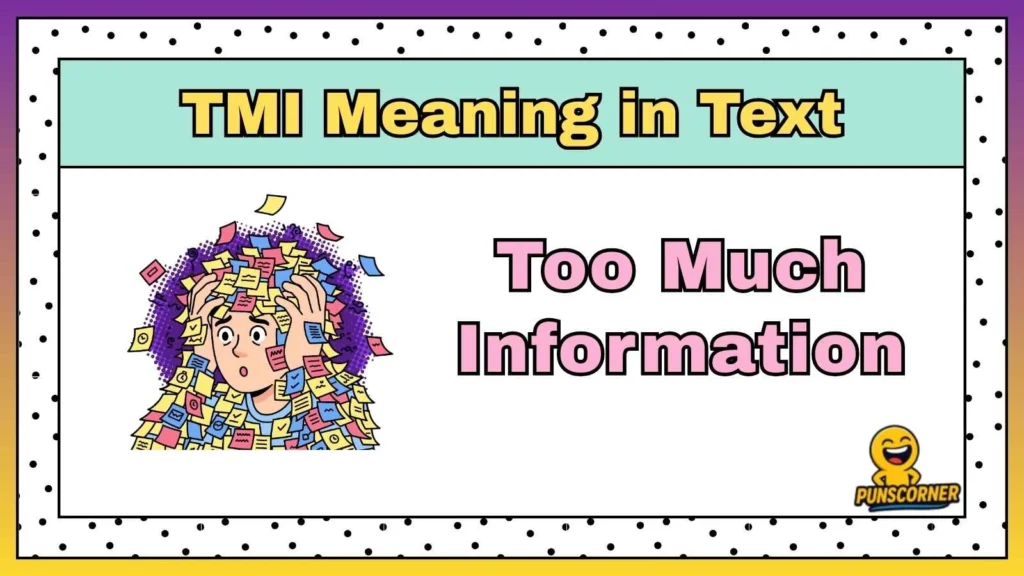
TMI stands for Too Much Information. It’s used when someone shares more details than necessary—usually something personal, awkward, gross, or overly specific. 🤭
You will often see “TMI” in chats when someone reveals details others didn’t ask for. The phrase can be funny, friendly, or light-hearted depending on the context.
Quick Breakdown:
- Full Form: Too Much Information
- Type: Slang / Internet Acronym
- Used When: Someone overshares or shares unnecessary details
- Tone: Casual, humorous, friendly
“TMI is one of the most popular texting slangs used to politely stop oversharing.”
Why Do People Use “TMI”? 🤔
People use TMI to keep conversations comfortable and avoid awkwardness. It works as a signal that a topic got too detailed or personal.
Common Reasons:
- To respond when someone shares personal or graphic info
- To jokingly tell a friend they’re giving unnecessary details
- To lighten the conversation with humor
- To gently stop someone from oversharing
The benefit of using TMI in text is that it’s short, friendly, and universally understood across social media platforms.
Examples of TMI in Real Text Conversations 📱
Here are practical examples so you can see how TMI works in texting.
| Situation | Message |
|---|---|
| Personal Oversharing | “I haven’t showered in 3 days.” → “Whoa, TMI!” |
| Funny Details | “My stomach made the loudest noise during the meeting.” → “LOL, TMI 😂” |
| Medical Details | “The doctor said my foot infection…” → “Stop! TMI 😅” |
| Relationship Details | “We kissed for like 20 minutes…” → “Bro, TMI.” |
These examples show that the term is usually used in a light humorous tone.
Is TMI Rude? Understanding the Tone
No—it’s usually not rude. The slang is designed to be casual and playful. The tone depends on how it is used.
When It’s Friendly 😊
- Used between friends
- Accompanied by emojis
- Used jokingly
When It Can Sound Rude 😐
- If used with an irritated tone
- Without context
- In professional settings
It’s best to use TMI only with people who know your communication style.
Where Do People Commonly Use TMI? 📍
1. Text Messages
Most common usage—quick, short replies.
2. Instagram or Facebook Comments
When someone shares personal stories online.
3. TikTok or Reels
Often used in funny reaction captions.
4. YouTube Chats & Streams
Used to tease someone who overshares live.
5. WhatsApp Groups
Extremely common in family or friends’ groups during casual conversations.
Different Meanings of TMI in Various Contexts
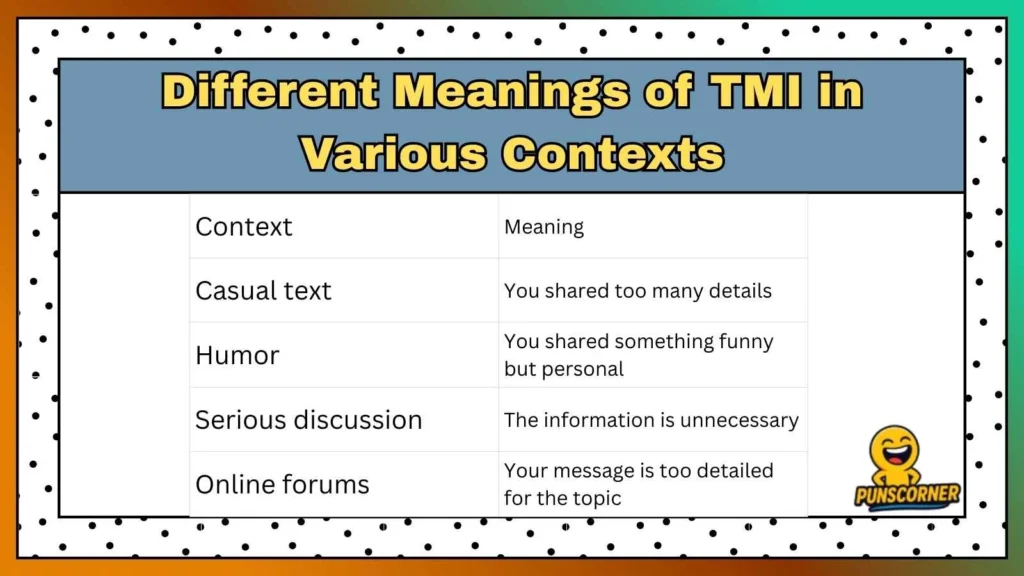
Although TMI mostly means “Too Much Information,” its interpretation may slightly change depending on the context.
| Context | Meaning |
|---|---|
| Casual text | You shared too many details |
| Humor | You shared something funny but personal |
| Serious discussion | The information is unnecessary |
| Online forums | Your message is too detailed for the topic |
Similar Slang Terms Related to TMI
- BTW: By The Way
- FYI: For Your Information
- IDK: I Don’t Know
- OMG: Oh My God
- LOL: Laugh Out Loud
- BRB: Be Right Back
These acronyms appear alongside TMI in text during informal chats.
How to Use TMI Properly (With Examples)
Using TMI correctly makes conversations smoother. Here are some example sentences:
1. Friendly Use
“You told me your entire morning routine. TMI but funny 😂.”
2. Playful Use
“Bro, that was way TMI! 😅”
3. Soft Warning
“Okay, TMI. Let’s change the topic.”
4. Humor in Reaction
“TMI alert! 🚨 But go on.”
Is TMI Used Professionally?
No, TMI is not ideal for professional communication.
In work emails, chats, or meetings, slang like TMI appears too casual and may reduce clarity.
Better Alternatives at Work:
- “That may be more detail than needed.”
- “Let’s stay on topic.”
- “This information may not be relevant.”
Why Understanding TMI Matters in Modern Digital Communication
Knowing slang like TMI meaning in text helps you:
- Communicate more naturally
- Understand online humor
- Stay updated with modern slang
- Avoid awkward conversations
- Connect with younger audiences
Language evolves quickly. Staying updated gives you confidence in every conversation.
TMI vs Oversharing — Are They the Same?
Not exactly. While related, they have differences.
| Term | Meaning |
|---|---|
| TMI | A *reaction* to unnecessary details |
| Oversharing | The act of sharing too much information |
TMI is the response. Oversharing is the action.
Common Misunderstandings About TMI 🚫
- ❌ It does NOT mean someone is offended.
- ❌ It doesn’t always mean the topic is inappropriate.
- ❌ It’s not used in serious or professional conversations.
Most of the time, people use TMI as a friendly reaction, not criticism.
How TMI Became Popular (Short History)
The acronym TMI has existed since the early 1990s but became globally popular with texting, memes, and social media. Its rise is connected to:
- SMS language evolution
- Internet chat rooms
- Social media culture
- Reaction memes
Today, it’s one of the most recognized internet slangs worldwide.
When *Not* to Use TMI ❗
Avoid using TMI in these cases:
- Formal communication
- Work chats or emails
- With elders who may not understand slang
- With someone sharing something serious or emotional
Use judgment to keep the tone respectful and appropriate.
FAQs
1. What does TMI mean in text?
It means Too Much Information—a humorous way to say someone shared unnecessary details.
2. Is TMI rude?
Not usually. It depends on tone. Most people use it jokingly.
3. Can I use TMI at work?
No, it’s informal slang. Use professional alternatives instead.
4. What is the full form of TMI?
The full form is Too Much Information.
5. What can I say instead of TMI?
You can say: “That’s too detailed,” “Let’s keep it simple,” or “More than I needed to know.”
Conclusion
The phrase TMI meaning in text is essential in modern communication. It helps you react playfully, stop oversharing, and keep conversations enjoyable.
Once you understand when and how to use it, your digital communication becomes smoother and more expressive.
Use TMI wisely, keep conversations fun, and stay updated with modern slang! 🚀